




Home
Our company
- Our commitment to sustainability
- 天美影院 2025: Growing societal impact globally

天美影院 2025:
Growing societal impact globally
As a leading medical technology company, we are committed to advancing healthcare while addressing key challenges such as threats from the rise in non-communicable diseases, workforce shortages, gaps in equitable access, and environmental impact on people鈥檚 health. This commitment to the health of people and the planet is why sustainability is embedded in our purpose, inspiring and influencing everything we do.鈥�
Our sustainability priorities address these key challenges. By expanding access to healthcare, preserving our planet鈥檚 resources, developing an engaged workforce and working with our partners and customers globally, we drive long-term value creation for our stakeholders and contribute to a resilient future for healthcare.
We are a global team united by an inspiring purpose: We pioneer breakthroughs in healthcare. For everyone. Everywhere. Sustainably. This drives us to advance healthcare access globally and address environmental challenges to create a resilient and sustainable future for healthcare. Consequently, we have integrated sustainability into our business priorities companywide.
Bernd Montag, Chief Executive Officer of Siemens Healthineers

Our Annual Report with integrated 天美影院 Report 2025
Our CSRD 天美影院 Report which is integrated into our Annual Report 2025, has been prepared in accordance with the regulatory framework of the Corporate 天美影院 Reporting Directive (CSRD) and the European 天美影院 Reporting Standards (ESRS). It provides a comprehensive summary of our sustainability strategy, targets, policies, and actions. These extend across our material impacts, risks, and opportunities within the areas of environment, social, and governance.
天美影院 Impact 2025
The 天美影院 Impact 2025 publication provides a compact summary of our sustainability strategy and highlights achievements across our pillars of impact in fiscal year 2025. It also includes an outline of our innovation and governance priorities that underpin our sustainable performance as a company.
Key achievements in fiscal year 2025
We measure our progress through key performance indicators defined for the three pillars of our sustainability commitment: Healthcare Access, Resource Preservation, and Diverse and Engaged Healthineers. These are supported by two key enablers: Volunteering and Employee-led Initiatives, and Global & Regional Partnerships.
This year, we made credible progress in expanding healthcare access, reaching 3 billion patient touchpoints worldwide, with more than 1 billion in low- and middle-income countries. We also delivered over 5 million hours of training to healthcare professionals, supporting them to upskill and deliver high-quality care.
Building on our commitment to resource preservation, we drove significant reductions in greenhouse gas emissions, reducing Scope 1 and 2 emissions in our own operations by 49%, and material Scope 3 emissions across the value chain by 4.5%. Our employee engagement scores are in the top 5% of the healthcare industry. This year, we are honored to have also been recognized as one of Fortune World鈥檚 Best Workplaces.
In fiscal year 2025, we reached 3 billion patient touchpoints worldwide, with over 1 billion in low- and middle-income countries. Our products and solutions have expanded impact for patients in underserved communities globally 鈥� driving early diagnosis and enabling comprehensive care especially for cancer, cardiovascular diseases, and stroke.
- Healthcare Access
In fiscal year 2025, we provided over 5 million hours of training for healthcare professionals and worked with healthcare providers globally to address capability and capacity gaps in the workforce.
- Healthcare Access
We are systematically driving decarbonization in our own operations and value chain. Our Scope 1 and 2 emissions declined to 127 kilotons of CO2 in fiscal year 25. This equates to a 49% reduction since the baseline year 2019. We have also reduced our emissions across our value chain (Scope 3) by 4.5% compared to 2019, by working closely together with our suppliers and customers.
- Resource Preservation
We engage with our employees continuously to prioritize areas of improvement that can enhance their experience, support their development, and foster well-being. This year, our engagement score, which is based on monthly data-driven feedback, positioned us in the top 5% of the healthcare industry.
Diverse and Engaged Healthineers
For the first time in our history, we鈥檙e honored to be have been named one of the 25 Fortune World鈥檚 Best Workplaces by Great Place To Work in 2025. This global recognition celebrates our ongoing commitment to building an inclusive, fair, and empowering workplace where everyone can thrive.
Diverse and Engaged Healthineers
Our employees have already volunteered over 46,500 hours. In doing so, they are activating our purpose throughout the world, contributing to our sustainability pillars, and creating meaningful impact for communities. We aim to grow these contributions and commit to achieving 100,000 hours of volunteering by 2030.
Diverse and Engaged Healthineers
天美影院 Impact 2025
Here are a few examples that show how we are already creating impact in each of our sustainability pillars. For more examples and to see all our sustainability indicators across environmental, social, and governance areas,
Bridging cancer care gaps in Indonesia
Through Healthcare Access, we advance technology, overcome barriers in low-resource settings, and transform the system of care for patients who are underserved and vulnerable.
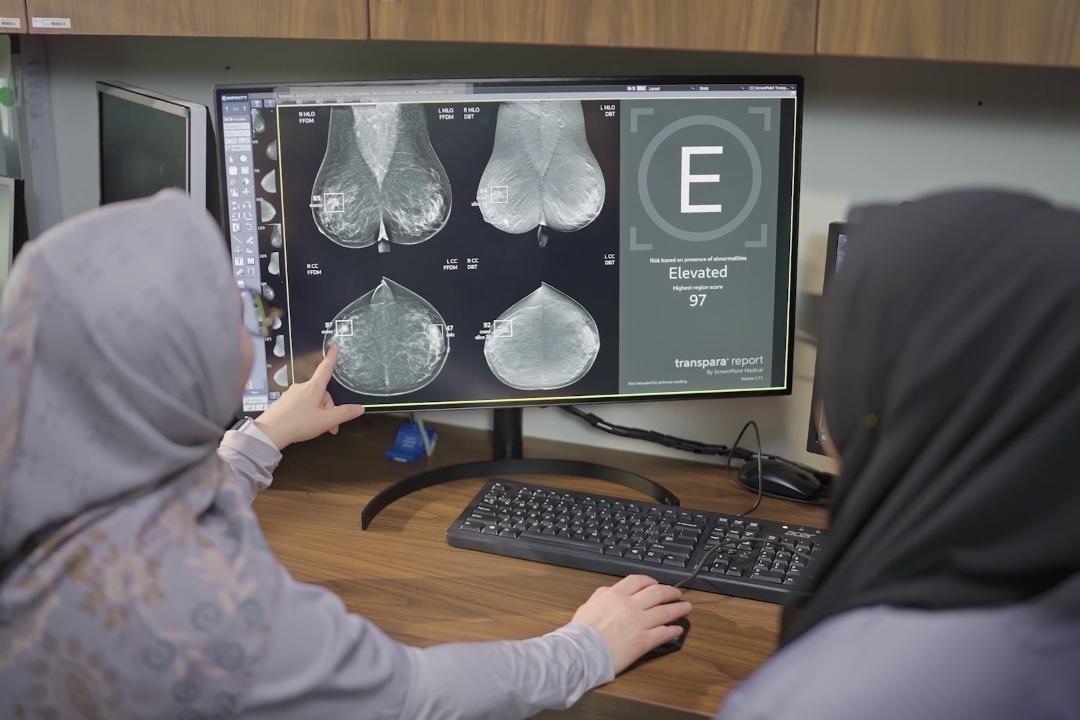
We are making progress in increasing healthcare access in remote regions especially to address non-communicable diseases. Indonesia, for example, faces a significant breast cancer burden due to limited screening access and a shortage of experts. A total of 73% of patients are diagnosed at late stages. To address these challenges, Siloam Hospitals Group launched a free screening program in 2023, reaching over 32,000 women in high-risk areas. To help overcome the shortfall in specialists, the group uses Transpara, an AI-powered radiology decision-support tool from ScreenPoint Medical in partnership with Siemens Healthineers. It assists in reading mammograms, provides a second opinion, and reduces radiologists鈥� workload.
Partnering for energy-efficient radiology
To reduce energy consumption in radiology, University Hospital Basel in Switzerland is advancing efficiency through its long-standing partnership with Siemens Healthineers.

The teams are identifying energy-saving opportunities 鈥� from powering down scanners overnight to refining MRI cold heads, which maintain the superconducting magnet鈥檚 temperature. The aim is to operate the systems more efficiently and lower their long-term environmental impact. A key lever is detailed energy monitoring across imaging modalities using measurement devices and log data. Results show that targeted shutdowns and smart low-energy modes are highly effective. For instance, turning off a computed tomography system whenever feasible, such as overnight or during extended idle times, can cut energy use by up to 40%.
Uplifting others through our shared journey
EmpowerME is our Employee Resource Group for employees navigating cancer 鈥� whether in treatment, surveillance, or survivorship. The group creates space for connection and support.

Through storytelling, photo shoots and advocacy days, the group brings colleagues and patients together, sparking friendships across backgrounds and roles. Participants describe these moments as life-changing reminders that our mission is deeply personal, and say they turn shared challenges into strength, compassion, and lasting impact.
Downloads
- (pdf, 9065.08 KB)(pdf, 12270.94 KB)(pdf, 8169.22 KB)(pdf, 2475.23 KB)
All trademarks are the property of their respective owners.